
Why Most Lifters Never Bench 315 (And How to Finally Get There)
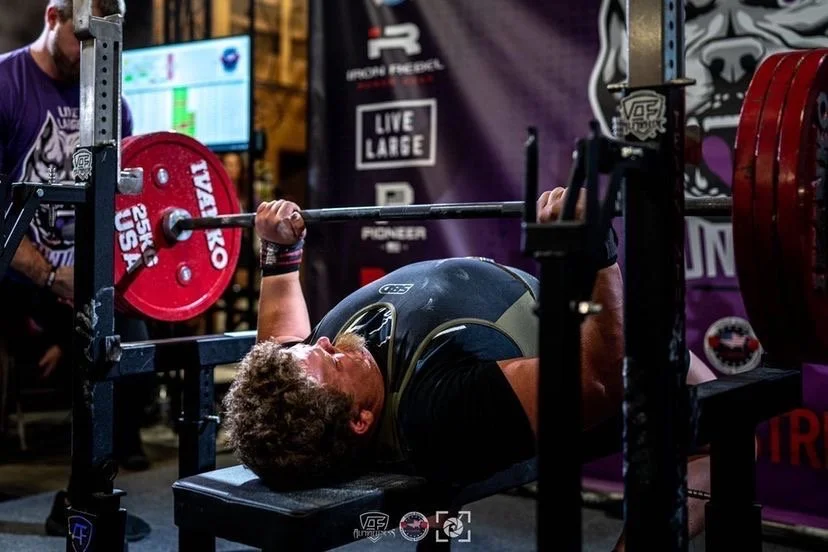
If there is one lift that has become the universal measuring stick for strength, it is the bench press. Nobody walks into a gym and asks how much you leg extension. Nobody cares what your cable fly max is. The question that has echoed through weight rooms for decades is simple: "How much do you bench?" Whether you're a powerlifter, a bodybuilder, a football player, or just some guy trying to impress his friends, the bench press has become synonymous with upper-body strength.
Within the bench press world, there is one number that seems to stand above all others. Three hundred and fifteen pounds. Three plates on each side of the bar. For many lifters, it represents the point where people stop seeing you as someone who lifts weights and start seeing you as someone who is genuinely strong. It is heavy enough to demand respect, but attainable enough that most lifters convince themselves they can get there eventually.
The problem is that "eventually" never comes for most people.
Over the years, I have worked with powerlifters, strongman competitors, athletes, and everyday lifters. One thing I have noticed is that most people who fail to reach a 315-pound bench press do not fail because they are genetically incapable. They fail because they repeatedly make the same mistakes while expecting different outcomes. They spend years chasing shortcuts, secret exercises, magic programs, and miracle supplements instead of addressing the actual factors that build a bigger bench press.
The funny thing is that many lifters know exactly what they need to do, but they do not want to do it because it sounds boring. They would rather watch a social media influencer explain why some exotic variation from Eastern Europe is the missing piece of their bench press than accept that their triceps are weak, their technique is inconsistent, and their bodyweight has not changed since high school.
Strength Is Built, Not Tested
Before we discuss specific exercises and programming strategies, we need to establish an important principle. Strength is not something you test. Strength is something you build.
One of the biggest mistakes lifters make is turning every bench workout into a competition. Every Monday becomes an opportunity to see what they can lift rather than an opportunity to improve what they can lift. They load the bar with weight they have no business touching, grind through ugly repetitions, miss lifts they should never have attempted, and then wonder why their progress has stalled.
Imagine a farmer planting seeds and then digging them up every morning to see if they have grown. Eventually, he is not going to have much of a crop. The same thing happens with strength training. Constantly testing your bench press is one of the fastest ways to slow down your progress because testing and training are not the same thing. The strongest bench pressers are usually not the people who max out every week. They are the people who accumulate months and years of productive training sessions.
The journey to a 315 bench press begins with accepting that strength is a long-term project. Most people underestimate how much work is required because social media has distorted their expectations. They see highlight reels of massive lifts and personal records but rarely see the years of consistent training that made those lifts possible. What appears to be an overnight success is often the result of thousands of repetitions performed correctly over a very long period of time.
You Probably Need More Muscle
Another uncomfortable truth is that many lifters simply do not have enough muscle to bench 315 pounds. I realize this statement is not as exciting as discussing advanced programming concepts, but muscle remains one of the primary drivers of strength. While technique, leverage, and neurological efficiency all matter, there is no escaping the reality that larger muscles generally have a greater capacity to produce force.
This does not mean that everyone needs to become a bodybuilder. It does mean that if your bodyweight has remained unchanged for the last five years and your bench press has not improved either, those two facts may be related. One of the strangest things I see in the fitness industry is lifters who want to add one hundred pounds to their bench press while refusing to add five pounds to their bodyweight. They want the performance of a larger athlete without developing the physical qualities of a larger athlete.
Now, before someone points out that a lightweight powerlifter can bench 315 pounds, understand that exceptions do not invalidate general principles. Elite lifters are exceptional by definition. Most people reading this article are not elite powerlifters. They are regular lifters trying to become stronger. For those individuals, increasing muscle mass is often one of the most effective ways to improve strength.
Build the Muscles That Drive the Bench Press
When I evaluate a lifter whose bench press has stalled, one of the first things I examine is muscle development. Are the triceps growing? Are the shoulders becoming more developed? Is the upper back getting thicker and stronger? Has the chest actually increased in size? If the answer to all of these questions is no, then it becomes difficult to justify expecting major improvements in pressing strength.
The muscles involved in the bench press are not particularly mysterious. The pectorals contribute significantly during the bottom portion of the lift. The anterior deltoids assist with shoulder flexion and pressing mechanics. The triceps are heavily responsible for finishing the movement and locking out heavy weights. The lats help control the descent and stabilize the shoulder joint. The upper back provides the platform from which force is generated. When these muscle groups grow stronger and larger, the potential for a bigger bench press increases.
Unfortunately, many lifters train these muscles inefficiently. They spend enormous amounts of time chasing a chest pump while neglecting the muscle groups that often determine success or failure under heavy weights. They perform endless variations of flyes, cable crossovers, and machine presses while avoiding the hard work of building stronger triceps and a more powerful upper back. Then they become frustrated when their bench press stalls despite feeling sore after every workout.
A bigger bench press is rarely the result of one magical exercise. It is usually the result of developing the entire system that supports pressing strength. This includes not only the prime movers but also the stabilizers and supporting musculature that allow force to be transferred efficiently throughout the body.
The Bench Press Is a Full-Body Lift
Perhaps the biggest misconception surrounding the bench press is the idea that it is merely a chest exercise. While the chest is certainly important, elite bench pressers understand that the lift is a full-body movement. The feet, legs, glutes, upper back, lats, shoulders, chest, and triceps all contribute to successful performance. When one link in that chain is weak, the entire lift suffers.
Watch a novice bench press and watch an experienced powerlifter bench press. The difference extends far beyond the amount of weight on the bar. The experienced lifter creates tension throughout the entire body. Their feet are firmly planted. Their upper back is tight. Their shoulders are locked into position. Their torso is stable. Every part of the body contributes to moving the barbell.
The novice often approaches the bench press like a chest workout. They lie down, grab the bar, and start pressing. There is very little attention paid to stability, tension, positioning, or force transfer. They may possess the muscular strength to lift more weight, but they fail to express that strength because their technique leaks force at every stage of the movement.
Technical Mistakes Become Expensive at Heavy Weights
This is one reason technique becomes increasingly important as the weights get heavier. You can get away with poor mechanics at 135 pounds. You can often get away with them at 225 pounds. As you approach 315 pounds, however, technical inefficiencies become much more costly. Small errors in setup, bar path, elbow position, and upper-back stability can easily cost twenty or thirty pounds on your bench press.
The frustrating part is that most lifters never realize these problems exist. They simply assume they need a different program or another accessory exercise. In reality, they are attempting to build a skyscraper on a weak foundation. Until the technical issues are addressed, progress will remain limited regardless of how much effort they invest.
Weak Triceps Are Usually the Real Problem
If I had to identify one muscle group that prevents more lifters from reaching a 315-pound bench press than any other, it would be the triceps. While many lifters immediately assume their chest is the limiting factor, the reality is that most failed bench presses do not occur on the chest itself. More often than not, the bar moves relatively well through the bottom portion of the lift before slowing dramatically somewhere around the midpoint. At that moment, the chest has already contributed much of its work and the triceps are being asked to take over. Unfortunately, many lifters have spent years prioritizing chest training while treating tricep work like an afterthought. They will perform multiple pressing variations, several chest isolation movements, and then finish their workout with a few rushed sets of pushdowns before heading home. Over time, this creates an imbalance where the musculature responsible for initiating the lift becomes significantly more developed than the musculature responsible for finishing it.
This issue becomes even more apparent as athletes approach heavier percentages. A lifter may be capable of performing multiple repetitions with 225 pounds yet completely stall when attempting a maximal effort because their lockout strength simply cannot keep pace with the rest of the movement. This is one reason why so many successful bench press programs place a tremendous emphasis on tricep development. Exercises such as close-grip bench presses, board presses, JM presses, weighted dips, and rolling dumbbell extensions have remained staples within strength programs for decades because they directly address one of the most common weak points in pressing performance. The goal is not merely to create a muscle pump but to progressively strengthen the triceps over time so they can contribute more force when heavier weights are introduced.
When evaluating your own bench press, pay attention to where you miss. If the bar consistently slows down several inches above your chest before eventually stalling, there is a good chance that your triceps are limiting your progress. Building stronger triceps will not instantly add fifty pounds to your bench press overnight, but over the course of months and years, it can be one of the most impactful investments you make. Many lifters spend enormous amounts of time searching for complicated solutions while ignoring the obvious one sitting directly in front of them. Strong benches are often built on strong triceps, and the athletes who understand this tend to make progress long after others have plateaued.
Most Lifters Never Learn How to Train Heavy
One of the most interesting things I have observed while coaching is that many lifters want the outcome of strength training without actually training for strength. They spend most of their time performing sets of ten to fifteen repetitions, chasing muscle pumps, and accumulating fatigue, but they rarely expose themselves to the intensities required to build maximal strength. There is certainly nothing wrong with higher repetition training. In fact, hypertrophy work plays an important role in long-term strength development. However, at some point, a lifter pursuing a 315-pound bench press must become comfortable handling heavy weights. Strength is a skill, and like any skill, it improves through repeated practice. A lifter who never handles weights above eighty percent of their maximum will often struggle when heavier loads are introduced because the movement feels unfamiliar. The setup changes, the bar speed changes, the level of concentration changes, and the athlete suddenly finds themselves in territory they have never practiced navigating.
This does not mean you should max out every week. In fact, frequent maximal attempts often create more problems than they solve. What it does mean is that your training should regularly expose you to heavier percentages. Top singles, doubles, and triples performed with excellent technique can teach you how to produce force under heavier loads without creating excessive fatigue. Many successful bench press programs utilize heavy singles throughout the training cycle, not because the goal is to set a personal record every week, but because they allow the athlete to develop confidence and technical proficiency under significant weight. Over time, this exposure helps bridge the gap between the strength you possess and the strength you can actually express on the platform or in the gym.
Most Lifters Train Heavy Too Often
While some lifters never train heavy enough, others make the opposite mistake and train heavy far too frequently. These are the individuals who approach every workout as a competition. If they benched 275 pounds last week, they feel obligated to attempt 280 pounds this week regardless of how they feel, what the program says, or whether they have recovered from their previous session. Eventually this approach catches up with them. Their joints become irritated, their progress stalls, and they begin associating bench day with frustration rather than improvement.
The reality is that strength is built through a combination of stimulus and recovery. Heavy training provides the stimulus, but adaptation occurs afterward. Lifters who constantly push maximal loads often accumulate fatigue faster than they can dissipate it. This creates a situation where performance stagnates despite tremendous effort. In many cases, the solution is not adding more work but managing intensity more effectively. Most successful strength programs include periods of heavier training balanced with periods of higher volume and reduced intensity. This allows athletes to continue building muscle, refining technique, and recovering sufficiently to make long-term progress. The strongest bench pressers are not necessarily the people who train the hardest on any given day. They are often the people who train intelligently over long periods of time.
Program Hopping Is Destroying Your Progress
The modern fitness industry has created an environment where lifters are constantly searching for the next breakthrough program. Every week a new training method appears promising unbelievable results. Social media is filled with influencers claiming to have discovered revolutionary systems that will add fifty pounds to your bench press in a matter of weeks. The problem is that most lifters abandon effective programs long before those programs have an opportunity to work.
Strength development takes time. Muscle growth takes time. Technical improvements take time. Unfortunately, patience is not particularly popular in the age of instant gratification. Many athletes will follow a program for three or four weeks, fail to see dramatic improvements, and immediately move on to something else. They never accumulate enough training volume, enough practice, or enough adaptation to experience meaningful results. Over the course of a year, these lifters may follow six different programs without giving any of them a legitimate chance to succeed.
The athletes who eventually reach a 315-pound bench press usually demonstrate a different mindset. They understand that successful programs are often repetitive. They are willing to perform similar exercises, follow similar progressions, and trust the process for months rather than weeks. While adjustments are certainly necessary over time, constant change is rarely the answer. More often than not, the problem is not the program itself. The problem is the lack of consistency applied to the program.
Recovery Is the Most Underrated Aspect of Strength Development
Many lifters obsess over training variables while completely neglecting recovery. They spend hours debating exercise selection, percentage prescriptions, and set structures, yet they routinely sleep five hours per night and survive on caffeine. Then they wonder why their strength is not improving.
Recovery is not a luxury. Recovery is a requirement. Every adaptation you hope to achieve from training depends upon your ability to recover from the stress you create. Sleep, nutrition, hydration, and stress management all influence your ability to build strength. A perfectly designed training program cannot overcome chronically poor recovery habits.
Sleep deserves special attention because it is often the easiest variable to improve and one of the most impactful. During sleep, the body repairs tissue, restores energy stores, regulates hormones, and prepares for future training sessions. Lifters who consistently sleep seven to nine hours per night tend to recover better, perform better, and make progress more consistently than those who do not. While improving sleep habits may not be as exciting as buying a new supplement or experimenting with advanced programming methods, it frequently produces better results.
Nutrition is equally important. Building a larger bench press requires adequate calories and sufficient protein. Many lifters attempting to maximize strength are simultaneously trying to remain as lean as possible year-round. While this approach may be beneficial for certain goals, it often limits strength development. The body performs best when it has the resources necessary to recover and adapt. Consistently underfeeding yourself while expecting maximal strength gains is a difficult strategy to sustain.
A Sample Bench Press Specialization Program
Want a sample program for the bench press? Click HERE to gain access!
Frequently Asked Questions
One question that comes up frequently is whether everyone can bench 315 pounds. The honest answer is no. Genetics, bodyweight, injury history, age, and training experience all influence an athlete's ultimate potential. However, many more lifters are capable of reaching 315 than currently believe they are. The number itself is not reserved exclusively for elite athletes. It simply requires a level of consistency and commitment that many people never maintain long enough to achieve.
Another common question is whether accessory exercises are necessary. The answer is yes, but only when they address actual weaknesses. Accessory exercises should support the main lift rather than replace it. If your triceps are limiting your lockout, tricep work makes sense. If your upper back lacks stability, rowing variations make sense. Randomly adding exercises because they appear on social media is rarely an effective strategy.
Many lifters also ask whether they should prioritize strength or hypertrophy. The answer is usually both. Muscle provides the foundation for strength, while strength training teaches the body how to express that muscle effectively. Successful bench press programs typically include elements of both approaches rather than treating them as mutually exclusive concepts.
Final Thoughts
A 315-pound bench press is not achieved through luck, secret exercises, or miracle supplements. It is the product of years spent building muscle, refining technique, strengthening weak points, and consistently applying sound training principles. Most lifters who fail to reach this milestone are not failing because they lack potential. They are failing because they repeatedly overlook the fundamentals while searching for shortcuts.
The good news is that fundamentals work. Building bigger triceps works. Developing a stronger upper back works. Training consistently works. Managing recovery works. Learning proper technique works. None of these strategies are particularly exciting, but they have helped countless lifters move from mediocre benches to impressive ones. If you are currently chasing a 315-pound bench press, stop searching for magic and start mastering the basics. Over time, those basics have a way of producing extraordinary results.