
How to Train Strongman Without Strongman Equipment
Strongman has exploded in popularity over the last decade. More people than ever are becoming interested in lifting atlas stones, carrying yokes, pressing logs overhead, and testing their strength in unconventional ways. Social media has made the sport more visible, local competitions are becoming more common, and many powerlifters and general gym goers are beginning to appreciate the appeal of strength expressed through movement and awkward objects. The problem, however, is that strongman equipment is still difficult to access for most people.
Most commercial gyms do not have strongman implements. Very few facilities have yokes, farmer handles, sandbags, logs, or circus dumbbells readily available. Even athletes with garage gyms may struggle to justify the cost of purchasing specialty equipment that can take up enormous amounts of space. As a result, many athletes assume they cannot properly prepare for strongman unless they train at a dedicated strongman gym. Fortunately, that is simply not true.
Strongman events are ultimately expressions of force production, stability, bracing, conditioning, and movement under load. The equipment matters, but the physical qualities behind the equipment matter even more. If an athlete can develop the qualities required for the event, they can make significant progress long before touching the actual implement.
This is especially important for beginners. Specificity certainly matters, particularly as competitions approach, but early on, general strength and athletic qualities carry over extremely well. A stronger back, better bracing mechanics, stronger hips, improved grip strength, and better conditioning will improve nearly every strongman event regardless of whether the athlete has touched a yoke or log before. Many athletes become overly focused on implements while neglecting the foundational qualities that actually drive performance.
Creativity is one of the most valuable traits a strongman athlete can have. The sport itself rewards adaptability. Every contest uses different equipment, different dimensions, different loading heights, and different event combinations. Athletes who can solve problems and adapt their training tend to perform better in unpredictable situations. Learning how to train effectively without ideal equipment can actually make someone a more resilient and capable athlete over time.
This article will discuss how to prepare for four major strongman events without having access to traditional strongman equipment. Specifically, we will cover:
• Yoke carries
• Farmer’s walks
• Sandbag loading
• Overhead pressing
By understanding the demands of each event and identifying exercises that develop similar qualities, athletes can continue building strength and improving their strongman performance no matter what equipment they have access to.
Understanding What Strongman Events Actually Demand
Before discussing exercise substitutions and creative alternatives, it is important to understand what strongman events are actually testing. Many athletes make the mistake of thinking the implement itself is the entire challenge, when in reality the implement is simply a tool used to express certain physical qualities. Once you understand what qualities each event demands, it becomes much easier to replicate those demands with basic gym equipment.
The yoke carry is often viewed as a leg exercise, but the movement is far more complex than that. A heavy yoke requires enormous amounts of midline stability and bracing strength. The athlete must maintain posture while dealing with massive spinal compression forces. Upper back strength becomes critical because the torso must stay rigid while moving. Foot stability and hip control also matter because any instability in the lower body gets magnified once hundreds of pounds are loaded on the athlete’s back. A successful yoke run is not simply about being strong enough to stand up with the weight. It is about being stable enough to move efficiently under crushing loads.
Farmer’s walks present a different challenge. Grip strength is the most obvious requirement, but the event also places a tremendous demand on posture and gait mechanics. The athlete must accelerate while holding heavy implements that constantly try to pull the shoulders downward and disrupt movement patterns. Upper back endurance becomes extremely important because posture often deteriorates before leg strength fails. Efficient footwork and breathing also play major roles in performance, especially during longer carries.
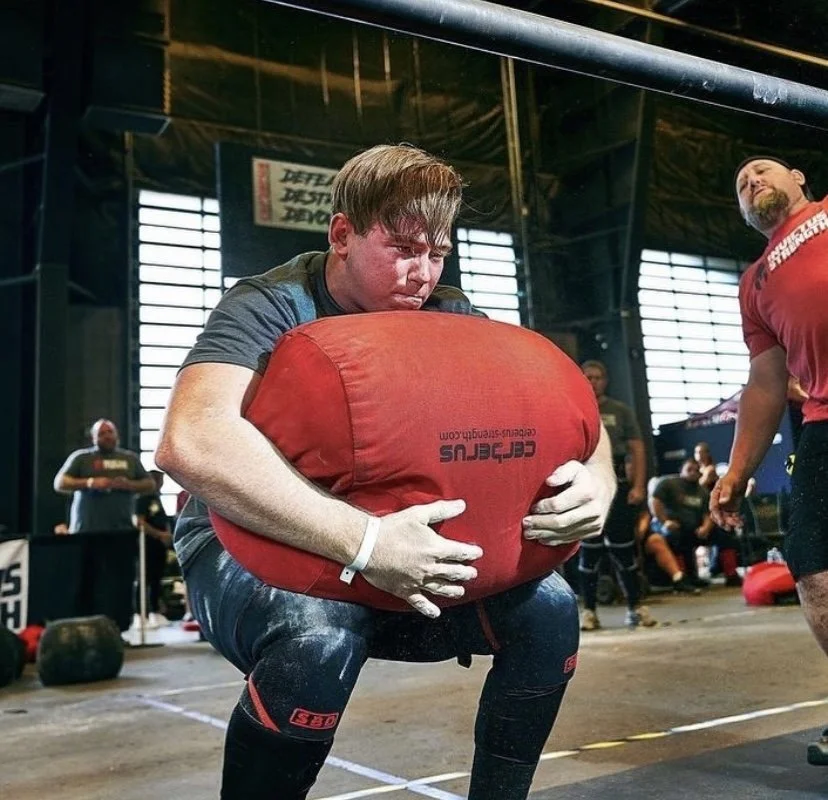
Sandbag loading introduces a unique combination of awkwardness, explosiveness, and conditioning. Unlike barbells, sandbags shift constantly during movement and lack stable handles. The athlete must brace against a front loaded object while generating enough hip extension power to elevate the bag onto a platform. Strongman athletes often fail sandbag events because their upper back collapses or because they cannot maintain position during the lap phase of the lift. Conditioning also becomes critical because repeated sandbag loads can quickly elevate heart rate and fatigue levels.
Overhead pressing in strongman requires far more than shoulder strength alone. While strong deltoids and triceps certainly matter, successful overhead athletes also possess strong upper backs, excellent trunk stability, and efficient leg drive. Most strongman pressing events involve using the legs to create momentum through push presses or jerks rather than relying on strict pressing strength alone. Thoracic extension and lockout stability are also essential for controlling awkward implements overhead.
Once athletes understand these qualities, the process of training without specialty equipment becomes far less intimidating. The goal is not necessarily to perfectly recreate the event itself. Instead, the goal is to recreate the demands of the event and strengthen the qualities that determine success.
How to Train the Yoke Without a Yoke
One of the biggest barriers to training strongman is the lack of access to a yoke. Most commercial gyms do not have yokes, they do not have space to carry them, and they certainly do not have thick crossbars designed for heavy carries. Despite this limitation, athletes can still prepare for yoke events extremely effectively with basic equipment.
One of the best exercises for replicating yoke demands is the heavy barbell walkout. This movement is incredibly simple but brutally effective. The athlete unracks a squat that is heavier than their normal squat max, walks backward two steps, sets their brace, and holds the position for time. These holds teach the athlete how to tolerate spinal compression while maintaining posture under maximal loads.
Heavy walkouts offer several benefits:
• Improve bracing mechanics
• Increase confidence with heavy weights
• Build upper back rigidity
• Develop stability under compression
Programming can remain fairly straightforward. Most athletes benefit from holds lasting between 10 and 20 seconds using supra maximal loads after their primary squat work. The goal is not movement speed but positional control.
Another excellent option is the safety squat bar march. If a gym has a safety squat bar available, athletes can use it to recreate the instability associated with yoke carries. Instead of walking long distances, the athlete simply marches in place while maintaining posture and trunk rigidity. Because the cambered design of the bar tries to pull the athlete forward, the movement heavily challenges bracing and upper back control.
Safety bar marches work well because they force stabilization during movement. The athlete cannot simply rely on passive positioning. Every step requires constant adjustments from the trunk, hips, and feet to stay balanced. This closely resembles the instability experienced during heavy yoke runs.
Zercher carries can also provide excellent carryover. Holding a barbell in the crooks of the elbows creates massive anterior core demands while forcing the athlete to stay upright under load. The exercise strengthens the upper back, teaches aggressive bracing, and improves the ability to move with awkward weight distributions. While it does not perfectly replicate spinal compression from a yoke, it does develop many of the same stabilizing qualities.
Heavy sled drags are another underrated option for yoke preparation. Sled work builds leg drive, conditioning, and movement efficiency without the same recovery cost associated with extremely heavy carries. Forward drags teach aggressive acceleration while backward drags can improve knee stability and quad endurance. Athletes who struggle with conditioning during yoke runs often benefit tremendously from consistent sled work.
Trap bar carries also deserve mention because they allow athletes to move with heavy weight while reinforcing posture and gait mechanics. While the load placement differs from a yoke, the exercise still teaches the athlete how to stabilize and move efficiently under stress.
When performing any yoke substitute, technique still matters. Athletes should focus on:
• Short controlled steps
• Aggressive bracing before movement
• Tight upper back positioning
• Stable foot contact with the ground
Even without a dedicated yoke, athletes can build the physical qualities needed to become significantly better at the event.
How to Train Farmer’s Walk Without Farmer Handles
Farmer’s walks are probably the easiest strongman event to replicate without actual strongman equipment. The movement pattern itself is relatively simple, and many gyms already have tools that can recreate the demands of heavy carries.
Heavy dumbbell carries are the most obvious substitute and remain one of the best options available. Carrying heavy dumbbells directly trains grip strength while forcing the athlete to maintain posture and move efficiently under load. Because each arm works independently, dumbbell carries also demand significant stabilization from the upper back and trunk.
Athletes can progress dumbbell carries in several ways:
• Increase the load
• Increase the distance
• Increase walking speed
• Reduce rest periods
Trap bar carries are another excellent option, particularly for beginners or larger athletes who may struggle with grip limitations early on. The trap bar allows significantly heavier loading and creates a more stable setup compared to independent handles. This can help athletes overload posture and movement mechanics without grip becoming the immediate limiting factor.
The drawback of trap bar carries is that they provide less grip challenge than traditional farmer handles. Because the implement is fixed together, stabilization demands are slightly reduced. However, the movement still develops many of the qualities required for strongman carries.
Suitcase carries are another highly effective variation that often gets overlooked. Instead of carrying weight in both hands, the athlete carries weight on one side only. This creates massive anti lateral flexion demands on the obliques and trunk. The athlete must resist being pulled sideways while continuing to walk efficiently.
Suitcase carries are particularly valuable because they strengthen the core in a way that directly transfers to strongman events. Strongman athletes rarely operate in perfectly symmetrical positions. Building unilateral stability can dramatically improve performance during awkward carries and loading events.
One of the biggest misconceptions about farmer’s walks is that they are purely strength based. In reality, they are heavily influenced by conditioning and strength endurance. Athletes who can pick up heavy weight but cannot control their breathing or maintain posture under fatigue often struggle badly during longer carries.
Farmer’s carries demand:
• Strength endurance
• Heart rate management
• Efficient breathing
• Short burst conditioning
This is why carries should not always be trained as purely maximal efforts. Longer distances, timed carries, and reduced rest intervals can all help athletes improve their conditioning for competition style events.
How to Train Sandbag Loading Without Sandbags
Sandbags are uniquely difficult because they constantly shift during movement. They lack handles, they pull the athlete forward, and they force the athlete to stabilize awkward loads throughout the entire lift. Even without access to sandbags, however, athletes can still recreate many of these demands.
Zercher squats are one of the best starting points. Holding the bar in the elbows teaches anterior loading mechanics while strengthening the upper back and trunk. The movement closely resembles the lapping position used during sandbag loads and teaches athletes how to brace against weight pulling them forward.
The biggest benefit of Zercher squats is that they force the athlete to stay rigid while maintaining posture under awkward loading conditions. This becomes extremely valuable during strongman events where the object itself constantly tries to collapse the torso.
Athletes can also create atlas stone alternatives using weight plates. Bear hugging heavy plates while carrying them or loading them onto a box helps recreate the awkward positioning associated with sandbags and stones. These movements teach hip extension timing and reinforce staying close to the object during movement.
Plate to box loads can become surprisingly difficult when performed for repetitions or under fatigue. Even though the load itself is lighter than a true sandbag, the positioning still challenges the athlete in similar ways.
Most athletes fail sandbag events because:
• Their upper back collapses
• Their hips are weak
• They cannot maintain position
This is why posterior chain strength becomes so important. Romanian deadlifts, Pendlay rows, and chest supported rows all help reinforce the positions required during sandbag loading.
Pendlay rows are particularly useful because they teach explosive upper back engagement from the floor. The athlete must maintain a rigid torso while generating force through the upper back and hips. This carries over extremely well to sandbag and stone loading mechanics.
RDLs strengthen the hamstrings and glutes while improving hip extension power. Chest supported rows help build upper back endurance without excessive lower back fatigue. Together, these exercises help create the structural strength necessary for successful loading events.
How to Train Strongman Overhead Press Without Logs or Circus Dumbbells
Many athletes assume they need a log or circus dumbbell to become good at strongman pressing events. While implementing specific practice certainly helps closer to competition, the reality is that stronger pressers usually become better log pressers regardless of the implement used.
The strict barbell press remains one of the best overhead exercises available. It builds raw shoulder strength, develops trunk stability, and improves lockout power. Athletes who struggle overhead often lack foundational pressing strength, and the strict press addresses that weakness directly.
Programming options can include:
• Heavy triples
• Moderate volume sets
• Paused repetitions
• Overload lockout work
Push presses become even more important because most strongman overhead events are not strict. Strongman rewards athletes who can efficiently transfer force from the lower body into the implement overhead. Push presses teach leg drive, timing, and explosiveness while allowing athletes to handle heavier loads than strict pressing alone.
Incline bench pressing can also carry over well to strongman overhead events. The movement strengthens the upper chest, shoulders, and triceps while reinforcing pressing mechanics that assist with lockout strength.
Dumbbell pressing variations provide additional benefits because they challenge stabilization and unilateral control. Single arm pressing forces the athlete to resist rotation while improving shoulder stability. Neutral grip pressing can reduce shoulder stress while still building pressing strength. Seated dumbbell presses help isolate the shoulders and upper back without relying heavily on leg drive.
Many athletes fail overhead lifts in the mid range or lockout position. Pin presses, dead stop presses, and banded pressing variations can help strengthen these weak points directly. These exercises teach force production from disadvantaged positions while improving confidence under heavier loads.
Accessory work should also remain a priority. Strongman overhead success depends heavily on supporting musculature including:
• Triceps
• Upper back
• Rotator cuff
• Core stability
Athletes who neglect these areas often plateau quickly or develop shoulder issues over time.
The Biggest Mistake People Make When Training Strongman Without Equipment
The biggest mistake athletes make when training strongman without equipment is becoming gym strong without becoming resilient. Many athletes focus exclusively on maximal lifting strength while neglecting the qualities that actually make strongman difficult.
Conditioning matters. Bracing matters. Grip matters. Work capacity matters. The ability to move under fatigue matters.
Strongman is not simply about producing force one time in a controlled environment. It requires athletes to repeatedly express strength while fatigued, out of breath, and under awkward loading conditions.
Strongman requires:
• Strength endurance
• Coordination
• Recovery between events
• Stability under awkward loads
This is why athletes should include circuits, carries, conditioning work, and odd object training whenever possible. Training outdoors occasionally can also help because strongman competitions rarely occur in perfect gym environments.
Whenever possible, athletes should embrace awkwardness rather than avoid it. Carry heavy objects, load strange implements, and challenge stability regularly. Strongman rewards adaptability, not perfection.
Conclusion
You do not need perfect equipment to become strong. While strongman implements are useful, they are not the sole determining factor behind progress. Athletes who understand the qualities behind each event can make tremendous improvements using basic gym equipment and creative programming.
Creativity can build elite strength. In many ways, learning how to adapt training around limited resources can actually make athletes tougher and more resilient over time. Strongman has always rewarded problem solving and adaptability, and those traits should carry into training as well.
At the end of the day, the basics still matter most:
• Squat
• Press
• Carry
• Pull
• Brace
The athlete who learns how to maximize these qualities will often outperform the athlete who relies entirely on specialty equipment.
Strongman is ultimately about expressing strength in difficult situations. The athlete who learns to adapt usually becomes mentally tougher and physically more capable than the athlete who only succeeds under ideal conditions.
Start with what you have available. Stay consistent. Focus on building the qualities that matter most. Perfect conditions are never required to become exceptionally strong.